ChildDevelopment

Why Handwriting Has Disappeared from Schools — And What That Means for Your Child

A former teacher reveals the simple system that's helping 60,000+ children master handwriting through play


Written by Dr. Hans Marcus 

Published on November 11, 2025

  • Pediatricians' Choice
150+ experts and pediatricians, including former teachers and child development specialists approved this as the solution for ages 2-8
Trusted by child experts

Every year, more than a million kindergartners fall behind by an entire semester.


Not because they lack intelligence.


Not because they aren’t trying.


But because of something most parents never realize to question.


Schools have quietly stopped teaching handwriting.


There’s no structured curriculum.


No dedicated time set aside for it.


Overworked and understaffed teachers are often forced to assume children will simply “pick it up” on their own.


Most don’t.


Instead, kids guess.


They hold the pencil incorrectly.


They start letters from the wrong direction.


And with every awkward attempt, they’re not just making mistakes — they’re reinforcing them.


Those mistakes turn into habits.


And those habits become harder to fix with every passing day.

Here’s what makes this especially concerning:


Between the ages of 3 and 7, a child’s brain is building the neural pathways that control handwriting for life. 


Occupational therapists refer to this period as the “motor memory window.”


Once that window begins to close, retraining the hand becomes extremely difficult — and in many cases, nearly impossible.


So the real question isn’t why schools stopped teaching handwriting.


It’s whether your child is already forming the wrong habits —
and what you can do right now to correct them before that window closes.

The Warning Signs Hiding in Plain Sight

You’ve probably noticed things you brushed off as “normal.”


The awkward, white-knuckle grip on the pencil.


The meltdowns that show up the moment homework starts.


The way your child suddenly avoids anything that involves writing.


The scribbles that should be letters by now — but aren’t.


These aren’t personality quirks.


They’re warning signs.


Here’s what most parents are never told: recognizing letters and writing letters are two completely different skills.


Your child likely knows their ABCs. They can sing the song, point to letters, maybe even recognize words. But writing isn’t a memory test — it’s a physical skill.


It’s muscle memory.


Just like riding a bike, handwriting requires the same correct movement repeated again and again until the hand remembers it automatically.


And this is exactly where traditional learning tools fall short.

Those popular dotted-line workbooks? 


They provide no physical guidance at all. 


Children can start letters anywhere, trace them backwards, or hold the pencil incorrectly — and nothing stops them.


So they practice… but they practice mistakes. Over and over.


Until those mistakes become permanent habits.


Tablet apps are even worse. Swiping a glass screen builds zero pencil control. The skills don’t transfer to paper — not even a little.


And disposable worksheets? One mistake and the page is done. Kids can’t repeat the same letter dozens of times to build real muscle memory. Meanwhile, parents spend $8–$10 every couple of weeks replacing them — hundreds of dollars a year on tools that quietly reinforce the wrong techniques.


Here’s the hard truth:


Every failed practice session doesn’t just waste time — it actively works against your child.

What a Former Teacher Discovered After Her Own Daughter Struggled

Sarah never expected to be on the other side of the parent-teacher conference.


With 10+ years as an educator specializing in child development, she thought she'd done everything right.


But sitting across from her daughter Emma's kindergarten teacher, she heard words that broke something inside her.


"Emma's handwriting is holding her back."


That night, watching her five-year-old cry through homework—tears streaming down her face as she struggled to form simple letters—Sarah made a decision.


The cheap Amazon workbooks weren't working. The apps were useless. Something fundamental was missing.


Drawing on her education background, she researched how children in top-performing countries actually learn to write.


What she found surprised her.

Finland. Japan. Singapore


The nations with the highest literacy rates don't rely on flat worksheets and dotted lines.


They use physical guidance systems—grooved templates that literally guide the child's hand through correct letter formation.


Montessori schools have used this approach for over a century.


The research is overwhelming: children need tactile feedback to build correct motor pathways.


They need to feel the right movement, not just see it.


Sarah spent three years developing a system based on these principles.


Not another workbook destined for the recycling bin. 


A complete handwriting development kit designed to work with how children's brains actually learn.


She called it TraceTrek.

The Three-Part System Behind 50,000+ Success Stories

What makes TraceTrek different isn't complicated. It simply addresses what every other approach ig nores.

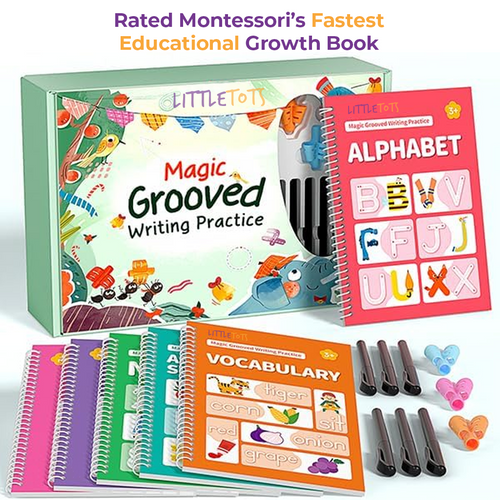
  • Grooved pages that physically guide the pencil

Each letter is carved into the page as a tactile channel. 


When children trace, their pencil drops into the groove and follows the correct path automatically. 


No guessing. No wrong strokes. No bad habits forming. 


One parent described it perfectly: "It's like training wheels for writing."

  • Magic disappearing ink that makes practice feel like play

Magic disappearing ink that makes practice feel like play. 


The specially formulated ink fades completely after about 20 minutes. 


Children can trace the same letter 50, 100, even 200 times on the same page They think they're racing against magic. 


They beg to "play" again. No more single-use worksheets. 


No more frustration when they make a mistake Just endless, engaging repetition that builds real muscle memory.

  • Ergonomic grip trainers that correct pencil hold naturally

The included grip tools position little fingers correctly without nagging or constant correction.


Children don't even realize they're learning proper technique. It just happens.


Together, these three elements create something parents consistently describe as "miraculous"—children who previously avoided writing suddenly can't get enough of it.

Bundle And Save

Get up to 4% OFF

% OFF

Build Better Writing Skills with LumoTrace

4.5

$39.00
$0.00

At vero eos et accusamus et iusto odio dignissimos ducimus

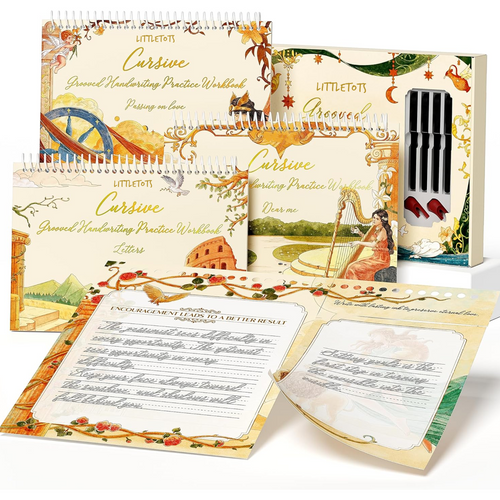
A child's hand is learning long before they form a proper letter. Scribbles and random marks are early steps toward writing, not something to rush past - and every child moves through this stage at their own pace. Knowing what stage your child is actually in makes it much easier to pick a handwriting workbook for kids that fits.

How Early Handwriting Develops It doesn't start with letters. First come marks, then straight lines, then curves - letters come later. A child moving from loose scribbles to steadier lines is already progressing, even if the letters still look uneven. Watching for that shift, instead of expecting neat letters right away, helps in choosing a handwriting practice workbook for children that matches where a child actually is.

What to Look for in a Beginner Workbook Not every workbook suits a first-time writer. A beginner handwriting magic workbook should start with lines, curves, and shapes before moving into full letters. Small wins worth noticing:

•    Steadier, less shaky lines
•    Better spacing between marks
•    Longer stretches of focus without frustration

These usually show up well before handwriting looks fully neat. A well-paced handwriting magic book for kids grows with the child, not ahead of them.

Support Beyond the Page Some children also need help with how they hold the pencil while writing. A handwriting grip trainer for kids is built for that - a separate tool used alongside practice, not a replacement for it.
Every child's handwriting journey looks a little different, and progress rarely happens overnight. Learn Lumo builds its handwriting practice books for kids around that same steady, well-paced progress.

TraceTrek™ Workbook: Fast Track Young Minds

Facial + body care

The complete Trace Trek set includes everything needed for comprehensive handwriting development:


✅ 4 workbooks covering Alphabet (uppercase and lowercase), Numbers 1-100, Math basics, and Drawing skills 


✅ Magic ink pens with multiple refills (the ink that disappears and lets children practice endlessly) ($15 value)


✅ Ergonomic grip trainers that teach correct pencil hold naturally ($14 value)


✅ Bonus: 2026 School-Ready Skills Starter Kit ($20 value)


Consider what parents typically spend: $8-10 every two weeks on disposable workbooks that reinforce bad habits and end up in the trash.


That's over $200 per year—on products that actually make the problem worse.


MotorMagic costs $37 once. The pages are infinitely reusable. The skills last a lifetime.


Right now, during the New Year Sale, the complete set is 67% off the regular $84 price.


And there's zero risk. The 30-day guarantee means if your child's handwriting doesn't improve, you get a full refund.

30 DAY GUARANTEE ON RESULTS 
67% OFF TODAY

Quantity

Used in 800+ Montessori Schools

Results in Just 1 Week

Approved by Pediatricians

Due to recent TV and News
appearances, stock is limited.

Frequently asked questions

Comprehensive answers provided by Sarah, Harvard-Trained Pediatrician and Founder of Your Little Explorer:


Title

What is different than other handwriting books?

Regular workbooks use dotted lines that kids trace once, then try alone and mess up. They're practicing wrong form over and over, building bad muscle memory. Our grooved workbooks have letters carved right into the page. Your child's pencil follows the groove like a train on a track. They physically can't form the letter wrong. Plus our ink disappears after 20 minutes, so kids want to do it again and again. Perfect practice, every single time.

Is this handwriting set right for my child?

If your child is between ages 2-8, yes. Whether they're just starting to learn letters, preparing for kindergarten, struggling with messy handwriting, or hating practice time, our system works. The grooves guide beginners perfectly and reset bad muscle memory for kids who learned wrong. We've helped over 50,000 kids at every skill level.

How long before I see results?

Most parents notice less resistance within days. Real handwriting improvement typically shows within 2-3 weeks. Teachers often comment within the first month. Full confidence and muscle memory develops over 2-3 months of regular practice. But you'll see progress much sooner.


Does this work for lefties too?

Yes! The grooves work the same for left-handed and right-handed kids. The carved letters guide whichever hand your child uses. Many left-handed parents tell us this is the first workbook that actually worked for their child because traditional methods always felt backwards to them.

Will my child become dependent on the grooves?

No! Think of grooves like training wheels on a bike. They build correct muscle memory until your child's hand knows the path automatically. Once that's locked in, they transition to regular paper naturally. Our method is used in 800+ Montessori schools and kids move to normal writing just fine.

What's included in the full set?

You get 4 grooved practice books covering Alphabet, Numbers, Math, and Drawing. Plus magic disappearing ink pens with refills, and silicone pen grip correctors. Everything you need in one complete system. The pages are reusable so one set lasts for years, not weeks.

30 DAY GUARANTEE ON RESULTS 
67% OFF TODAY

Due to recent TV and News
appearances, stock is limited.

The Window Won't Stay Open Forever

Schools aren't going to start teaching handwriting again. The curriculum has moved on.


The responsibility now falls on parents.


Your child has two possible futures.


In one, they continue struggling. Bad habits lock in permanently. Confidence erodes.


The frustration compounds year after year, affecting not just handwriting but their entire relationship with learning.


In the other, they master handwriting through play.


They walk into kindergarten—or first grade, or second—ahead of their peers.


They build confidence that carries into every subject. Writing becomes a strength, not a source of stress.


The difference between these futures might be a single decision made today.


Trace Trek comes with a 30-day money-back guarantee.

If it doesn't work, you pay nothing and keep the workbooks anyway. 


There is genuinely nothing to lose—except the opportunity, if you wait too long.


Your child deserves to feel confident when they pick up a pencil.


They deserve to see writing as fun, not punishment.


They deserve every advantage you can give them before that motor memory window closes.


This is how you give them that skills that they remember.