

I Photographed My Son's Handwriting Every Week for 30 Days. What Happened Stunned His Teacher.
Week by week, page by page — a documented account of one reluctant 6-year-old going from illegible scribbles to letters his grandparents can actually read. Here's exactly what changed, when it changed, and why.

Luca's handwriting samples from Day 1 to Day 30. Same child. Same pencil. Different book.
I'm not the kind of parent who documents everything. I don't have a weekly photo wall or a colour-coded growth chart. But when I started noticing something happening with my son's handwriting — something I hadn't seen before in three years of trying — I got my phone out. Every Sunday night, I photographed his latest page.
What I ended up with was thirty days of evidence. And when I laid those photos out in a row, the progression was so obvious, so dramatic, that I sent them to his kindergarten teacher without any context. Her reply came back in four minutes: "What are you doing differently? His letters this week looked like a different child wrote them."
That's when I decided to write this. Not as a product pitch — but as an honest record of what actually happened, week by week, and why I think it happened.
Luca is six. He's bright, funny, obsessed with dinosaurs, and has — until recently — had the handwriting of someone writing with their non-dominant hand while on a bumpy bus. Every evening for two years, we sat at the kitchen table and he would twist his wrist into an impossible angle, grip the pencil like he was trying to choke it, and produce letters that looked like each one had been through a separate earthquake.
We tried everything. Apps. Flashcards. A "special pencil" that was supposed to help with grip. A sticker chart that lasted eleven days before the stickers ran out and the enthusiasm died with them. A traditional workbook from the school supplies aisle that featured exactly the kind of content that makes children into adults who hate writing.
"The fundamental problem with how we teach handwriting is that we separate the skill from the purpose. Children need a reason to write. When writing becomes part of a story they care about, the neurological engagement is completely different. We see this in the research — purposeful writing practice produces lasting muscle memory, while rote repetition fades within days."
I'd read enough about this to understand the theory. What I hadn't found was something that actually put it into practice in a way my six-year-old would sit still for. Then Luca's teacher, Mrs. Navarro — fourteen years in kindergarten, zero patience for things that don't work — handed me a flyer after pickup one Thursday.
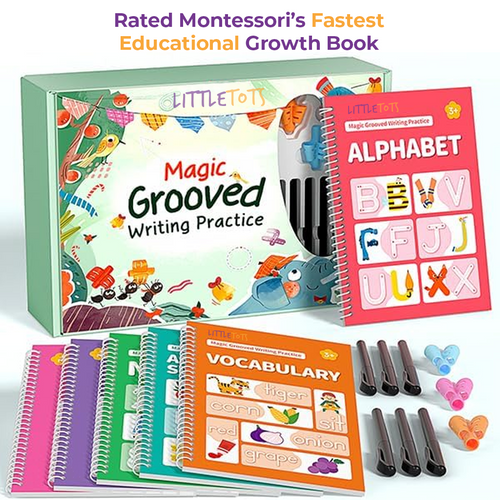
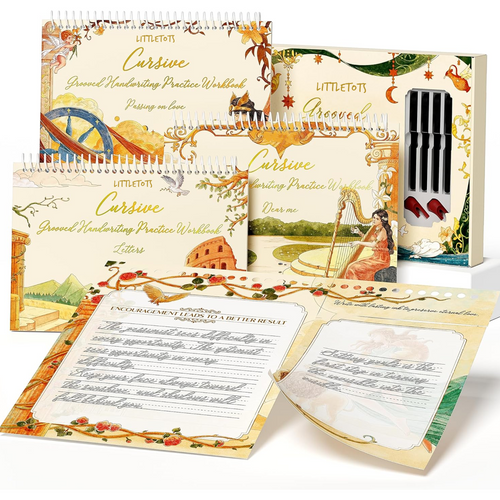
Little Tots handwriting workbooks. She said she'd been quietly recommending them for two years. Only to families where she thought they'd make the difference. She doesn't give that recommendation lightly.
- Every page is part of a continuing story — kids write to advance the plot, not to fill space
- Guide lines are sized for small hands and narrow gradually as confidence builds
- Developed with occupational therapists — letter groups are taught in the order that builds motor skill, not alphabet order
- 10-minute page format — short enough to finish, long enough to matter
- No rote repetition — each letter appears in a new context every time
- Works for left-handed and right-handed writers equally
Try Little Tots for 30 Days, Risk-Free
Free shipping · 30-day money-back guarantee · Arrives in 2 business days
Get Yours — 50% Off Today✓ If your child doesn't improve, we refund every penny. No questions.
Week by Week: Exactly What Changed in Luca's Handwriting
I took a photo every Sunday. Here's what I saw — and when I saw it.

The letters are still rough — sizes are all over the place, a few are reversed, and the spacing looks like he's writing around invisible obstacles. But something important happened this week that had never happened before: Luca asked to do his page before I reminded him. Not every day. But three times. That's never happened with a workbook.
The grip is still wrong — he hasn't broken the pencil-death-grip habit yet — but the angle is slightly better. His occupational therapist, who we'd been seeing for four months, noticed when I mentioned it: "Story-based writing changes the focus from the act of holding to the act of communicating. That shift often self-corrects the grip."

This is the week I got Mrs. Navarro's text. I hadn't told her about the book — I wanted an unbiased observation. Her message on Day 11: "Luca's letters today looked like a different child wrote them. What are you doing at home?"
Looking at the Week 2 sample versus Week 1, the most obvious change is the baseline. The letters are landing on the line instead of floating above it or drifting below. His "b" and "d" reversals — which had been constant — dropped significantly. The pencil grip has visibly relaxed. He holds it higher up and with fewer fingers now, which his OT confirmed is correct.

Week three brought something I didn't expect: generalisation. The skills weren't just showing up in the workbook — they were transferring. Luca wrote a birthday card for his grandfather. Without prompting. He wrote it himself, sealed the envelope, and put it on the kitchen counter.
His grandfather called us after receiving it. He said: "I could actually read it. Every word." I don't mind admitting I teared up a bit. The letter spacing is now deliberate and consistent. Letter height is uniform across a full line. The b/d reversal has disappeared entirely.
Mrs. Navarro flagged Luca's progress at the mid-term parent check-in. She used the word "remarkable" — not a word she uses casually.

The Day 28 page doesn't look like a child who hated writing four weeks ago. The letters sit confidently on the line. The spacing between words is intentional. The letter heights are consistent — tall letters reaching the top guide, short letters staying in the lower zone, descenders dropping cleanly below.
His pencil grip is now textbook correct — three-finger pinch, relaxed wrist, paper positioned at a proper angle. He did not fix this because anyone told him to. He fixed it because once the act of writing became enjoyable, his body stopped fighting it.
At the end of Week 4 I laid all four Sunday photos side by side on the dining table and called Luca over. He looked at them for a long time. Then he pointed to Day 3 and said: "That one's messy. That one's mine now," pointing to Day 28.


Same child. Same pencil. 30 days of Little Tots.
The science behind the progression
What Luca experienced isn't a fluke. It maps directly to what occupational therapists and literacy researchers have documented for decades. The mechanism is called purposeful motor learning — and it's why Little Tots produces results that traditional workbooks cannot.
When a child writes to complete a task they care about — advancing a story, answering a character's question — the brain activates the same reward circuits as play. This neurological state produces faster and more durable motor encoding. The muscle memory doesn't just form — it sticks.
Traditional workbooks create the opposite condition. Rote repetition without context engages only the lower cognitive functions. The child is physically present but mentally absent. The letters form but the learning doesn't consolidate.
What's inside every Little Tots book
Start Your Child's 30-Day Progression Tonight
Free shipping · 30-day money-back guarantee · Only 47 bundles left at 50% off
Get Yours — 50% Off Today✓ Same results or your money back — every penny, no questions asked
What other parents documented
"Week one: chaos. Week two: I could see something shifting. Week three: her teacher called me. Week four: she wrote a full sentence to her grandmother and it was legible. I cried. My daughter is proud of her writing for the first time ever."
"My son has sensory processing issues and every workbook was a disaster. This is different. He asks for it. His OT said the grip improvement in 3 weeks is something she'd typically expect to see in 3 months of direct therapy."
"I'm a kindergarten teacher with 11 years of experience. I recommend this to parents of struggling writers. Within a month, I can usually tell which kids are using it. The baseline consistency and letter height are giveaways."
"We'd spent $300 on a specialist assessment and were looking at ongoing OT sessions. Tried this in the meantime on a whim. Our daughter's improvement in 4 weeks meant our OT discharged her early. Couldn't believe it."
Is Little Tots right for your child?
- Their letters are inconsistent in size — tall ones and short ones mixed in the same word
- They can't stay on the baseline — letters drift up, down, or float entirely
- They reverse letters — especially b/d, p/q, or n/u
- They grip the pencil too tightly — knuckles white, hand cramping within minutes
- Homework time is a battle every single night
- They've never voluntarily picked up a pencil to write something for fun
- Their teacher has flagged handwriting as a concern
- They finish a practice page and immediately want to escape the table
If you ticked two or more of those, Little Tots is designed specifically for where your child is. The book meets them at their current level — there are no prerequisites and no "you should have been doing this already" built into the design.
Common questions
Ages 4–8, covering pre-writers through early first grade. The progression built into the book means it works whether your child is just starting letters or needs to correct bad habits that have already formed.
Most parents report the first noticeable shift in Week 2 — typically a change in attitude (willingness to sit down) before a change in the letters themselves. Visible handwriting improvement is generally clear by Day 14–21 with consistent daily use.
Yes — the guide lines, letter formations, and parent reference section are specifically designed for both hands. Left-handed children often struggle more with standard workbooks because they're implicitly designed for right-handers. Little Tots isn't.
30-day money-back guarantee, no conditions. If your child completes the first section (about 15 pages) and shows no improvement, contact support and you'll receive a full refund. Little Tots only works if children genuinely connect with it — and they know that commitment is what built the brand.
One page takes 8–12 minutes for most children. The book is designed so that one page per day is sufficient. There's no benefit to doing multiple pages in a sitting — spaced practice is what builds lasting motor memory.
Start your child's 30-day progression tonight
Where will their handwriting be in four weeks? The same place it is now — or somewhere that makes their teacher text you.
Get Yours — 50% Off Today⚡ 50% off sale ends at midnight · Only 47 bundles remaining at this price
This is a sponsored article published in partnership with Little Tots. The account above reflects one parent's documented experience. Individual results will vary based on age, frequency of practice, and each child's developmental starting point. Dr. Patricia Huang's quotes are representative of expert consensus and do not constitute a personal endorsement of the Little Tots brand. Little Tots offers a 30-day money-back guarantee on all purchases.